Keywords – Googleforms, KoboCollect, EpiCollect5, ODK, Fulcrumapp
A recent paper talks about disparity in quality of COVID-19 data being reported across India. We have been scrupulously taught during training that evidence based policy making, data driven governance is the way to go. From my experience of COVID-19 management during district training, I could witness this first hand. There were complaints from the state government that there is data duplication, multiple channels of data reporting, non-availability of certain data, even if available not reported in proper format etc. Not to speak of data visualization – spatially and temporally, gleaning actionable insights from the data collected.
All this assumes great significance in the context of COVID-19. The dictum, what cannot be measured, cannot be managed holds very true here. Given the numbers soup around COVID management – doubling rate, samples tested per day per million, Case Fatality Rate, Recovery Rate, Contacts traced per positive case etc, its only imperative that data is collected and reported in a foolproof manner. And most of the times, this data originates in the field be it – household survey for covid like symptoms, comorbidities, age and other vulnerabilities; data reported from the health centres or even data reported by other agencies.
In this article, we talk about a framework for collecting field data. We are going to talk about the process and tools mainly.
There are a number of field data collection apps/tools. Right from the most ubiquitous and famous tool Google forms to open source tools like ODK, Kobocollect, EpiCollect5 to paid tools like fulcrumapp. We are going to compare them and leave it to the readers to judge which one fits their bill. The parameters on which we are going to compare these tools range from price, utility, ease of use, scalability, android/apple support etc
Google forms
Each one of us has come across google forms a number of times. Its utility and ease of use lies in the fact that whoever has a gmail account, can create it within minutes and share it to anyone irrespective of the fact that, the person filling the form has a gmail account or not. There are no software downloads, no apps to be installed, no fees to be paid. It’s all free.
However the drawbacks are the person filling the questionnaire needs to be connected to the internet while submitting the form (no brainer, hehe). So using google forms in hard to access locations, in hilly terrain and trying terrains becomes difficult.
ODK/Kobocollect/EpiCollect5
These are open source field data collection tools developed by academic universities. These cater mainly to the research students who need to collect primary data from the field, often in remote and inaccessible areas – plant species with their location data, houses damaged in floods and earthquakes etc. And so they need to be robust, have offline feature, be collaborative, collect GPS coordinates, have some sort of admin privileges etc
Thanks to the open source community, with all the google forms’ features plus advanced features, these tools are free! And yes they work!
Fulcrumapp
Fulcrumapp contains all the features as the above open source tools. But it’s a paid software and hence comes along with it the customer support, extra security and aesthetics.
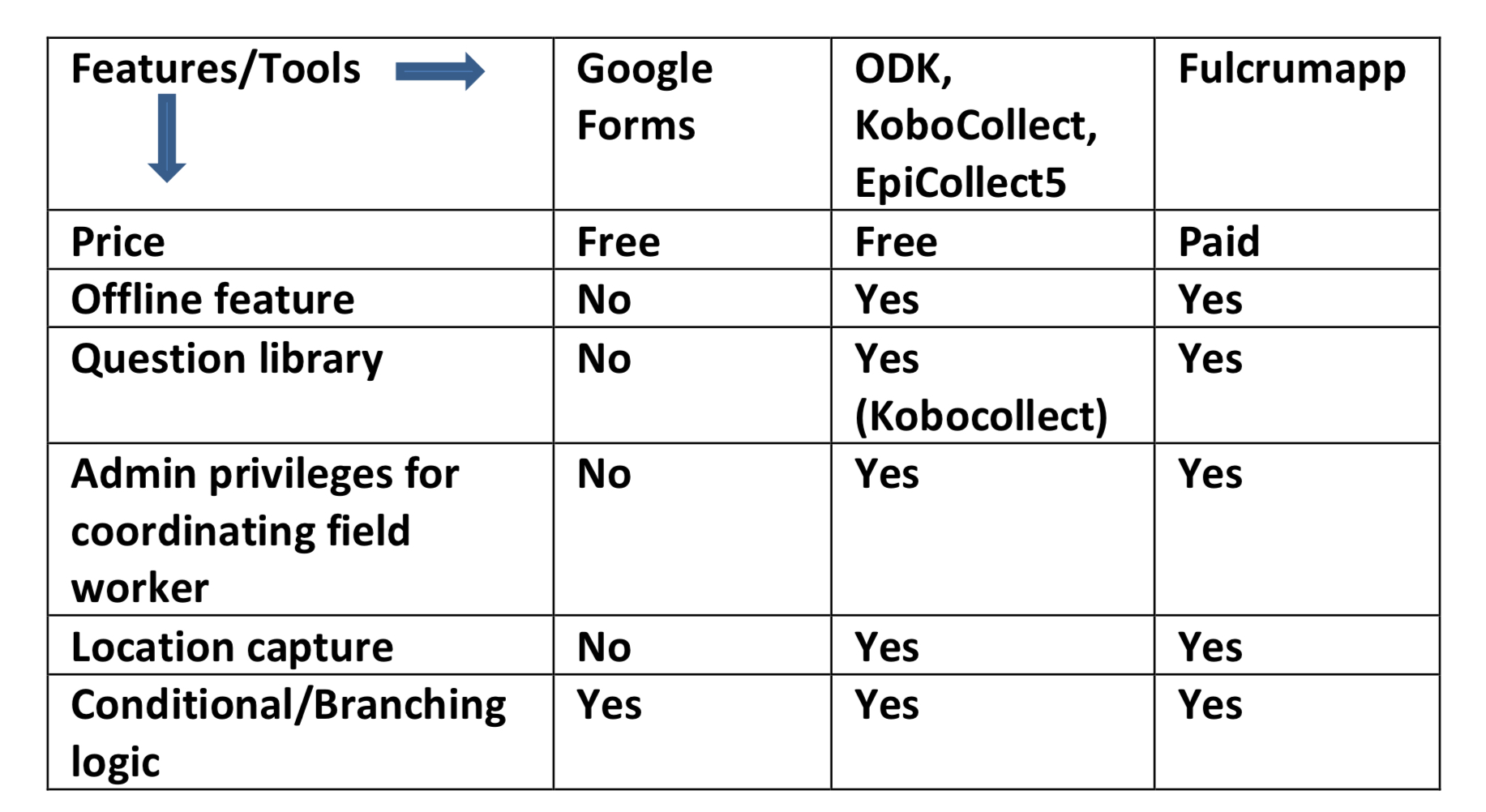
The following table compares all the above tools quickly:
My personal favorite so far has been the EpicCollect5. It’s simple, clean, free and yes it works!!!
Do let me know in the comment section your favourite tools. Also if you have come across a tool not discussed above, but awesome in every aspect, please let me know.
Thanks

 KEERTHI KIRAN PUJAR