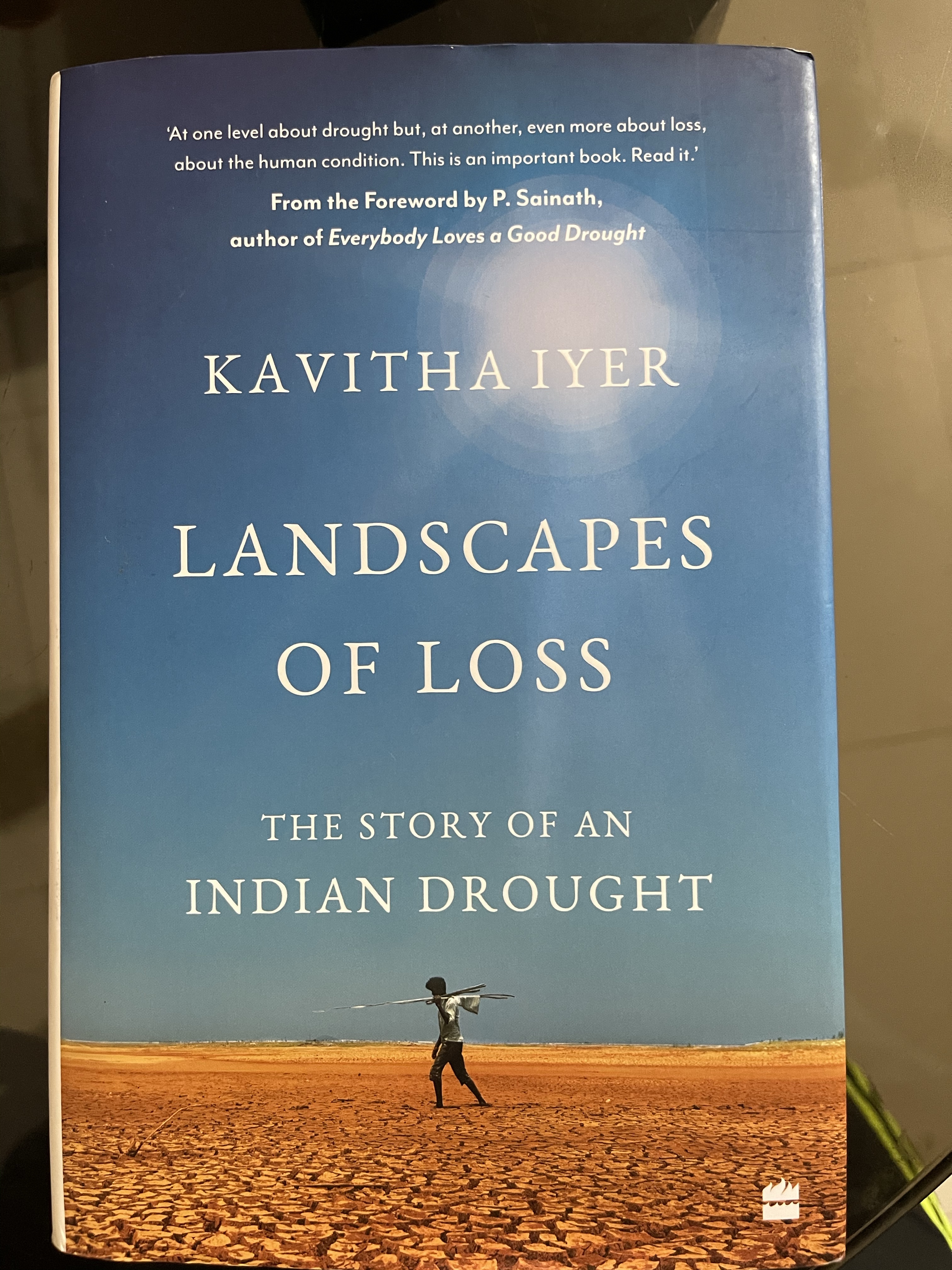
The book is predominantly about the hardships faced by the farmers, Dalits, landless labourers, farm widows, children of Marathwada. It also brings out the Socio-economic-cultural fallout of cyclical drought, unseasonal rains, unsustainable water practices. All along the author discusses the Govt’s interventions, schemes to tackle such hardships
The author address drought as ‘Complex Multifaceted Agrarian crisis’ suffered over long durations, impacting daily life, business, deprivation levels, health status and social dynamics. Marathwada owing to geography suffers from chronic aridity. The author says that drought is a worldwide trend from Zimbabwe to Australia to US, but in India it comes with peculiarities. In Marathwada, the peculiar combination of aridity and cyclical drought or abnormally dry spells has made farmers vulnerable. Drought in Marathwada comes with its own issues – Farmer suicides, debt trap, migration etc. The author notes that drought was there earlier also but sans farmer suicides. In the author’s own words “The Farmers are dying a slow death”.
The recent phase of drought started in 2012 and in last seven years, there have been four droughts!!
Govt measures to tackle drought – cattle camps, water tankers supply, waiver of land revenue, exam fees, loan waivers etc
Marathwada also has more peculiarities/abnormalities
- Being water deficit, there is high concentration of Distilleries stealing large share of water at dirt cheap rates even during summer!
- Only 38% of Irrigation potential created in Marathwada is converted into actual irrigation systems with canals and lift-irrigation schemes, compared to 47% in Vidarbha
- Three fourths of Marathwada farmers are small marginal and fragmented land owners
- Some political heavy weights – two former CMs and Dy CM come from Marathwada
What has brought us to this crisis?
The author traces this drought and agrarian crisis to 1990s when State govt actively promoted the Horticulture sector, the farmers who in turn became dependent primarily on underground water for irrigation. Now when the underground water has dried up, the farmers take loans to dig bore wells elsewhere on their farms, purchase water tankers to keep their plants alive, small farmers cut down their orchard for lack of water.
Another development which initiated this unsustainable agriculture practice is Sugarcane cultivation and dependence on water in large scale.
Adding my observation from field to this – Every farmer in this region needs a private well or bore wells if water source is not nearby. And that’s obvious – due to underdeveloped irrigation systems, canals, pipelines, the poor farmers have no choice than to depend on well. See my article on Govt sponsored well schemes
India is the world’s largest user of groundwater as per ADB report in 2016 – 251 cubic kilometers per year, more than twice the extraction by the US or China, or a quarter of the global total groundwater use.
So if there is unregulated exploitation of underground water, what is the Govt doing then?
The author dwells at length on Legal and technical framework to regulate the ground water extraction
The MH Govt in 2009 passed the Maharashtra Groundwater (Development and Management) Act – a law that was to facilitate and ensure sustainable, equitable and adequate supply of groundwater to various categories of users.
- Provisions for a State groundwater authority and district-level Bodies to manage and regulate the exploitation of groundwater. MWRRA is the apex body that decides on water allocation, tariffs and morE. MWRRA prohibits digging of wells deeper than 60m or 197 feet.
- Provisions for gazette notifications of areas where groundwater has improved or depleted, prohibiting any effluent release that could contaminate groundwater, funding the recharging of groundwater in suitable areas and prohibiting the drilling of deep wells
Across Marathwada tens of thousands of bore wells have been drilled since the enactment of the law. These are commonly up to 400-500 feet deep, a far cry from a half-hearted 2015 order by the MWRRA that prohibits bore wells deeper that’s 60m(197 feet) in notified areas where groundwater depletion is serious. There are also rules regarding how many bore wells may be permitted per sq KMs.
The rules under the Groundwater Act are yet to be formulated and therefore there is no implementation. Once implemented, these rules would mandate registration of existing wells and permissions before fresh well-digging.
The next thorny topic the author talks is Farmer Suicides. The author has critically evaluated the nuances of the issue. Maybe being a female and lending compassionate ears to the problems of young widows, the author brings out often overlooked issues like patriarchal mindset in recognising women’s rights. For ex, after a farmer dies, then the family of the farmer may implicitly or explicitly force the widow not to take ownership of the husbands land. Govt schemes like “Ghar doganche” launched to promote women’s property right though met with success in the district where launched, didn’t take off in the rest of the state.
Also women farmer who commit suicide don’t get counted as farmer suicide because they lack land in their name or most of the times they are just farm labourers.
A key policy or actionable take away for young CEOs or District Collectors is to provide a safety net for such highly vulnerable sections of society – orphans, widows, abandoned wives, destitute, say to facilitate families of deceased farmers – all the govt schemes and benefits that a widow should get will be streamlined through a single window mechanism
The final chapter talks about drought-proofing measures which are purportedly being taken up to solve the water shortage issues – like Interlinking river basins, Marathwada Water Grid, Jal Yukt Shivar Abhiyan. These are very big costly projects often running into various issues like land acquisition, cost sharing, opposition from environmentalists.
Overall, it was a good read especially as a budding civil servant. Being posted in Marathwada for last few months and seeing the things closely, I could appreciate many things from the book.
However the book seems too verbose at times while bringing out the struggles of the people. The author being a journalist, has lent a journalist flavour to the book. The book might appear as a series of opEds, articles stitched together. Also the author seems to focus mainly on few districts in Marathwada- Jalna, Aurangabad, Beed.
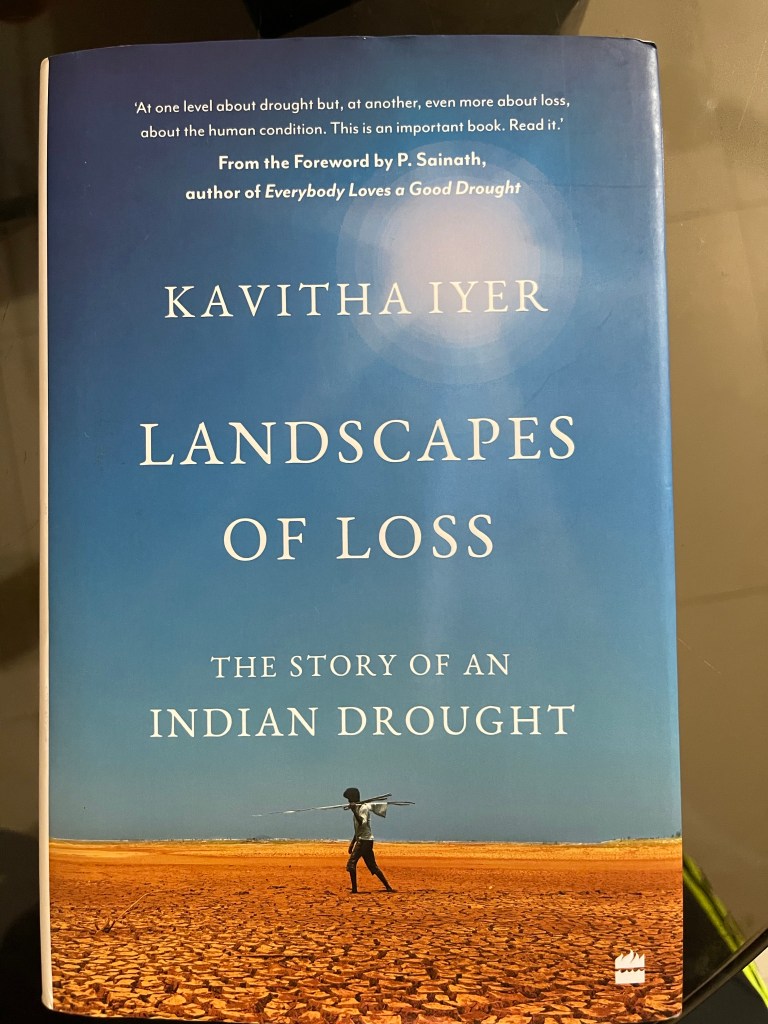

 KEERTHI KIRAN PUJAR
👌👌👍👍
LikeLike
Nice sir 👍👍
LikeLike